Important notice - We are aware of a scam where people are impersonating CMD Recruitment to offer jobs via WhatsApp & Telegram. This is a scam, CMD Recruitment will never contact new candidates via these methods. Any legitmate offer from CMD Recruitment would be made via a telephone call.

CMD Ident
Accountancy.
CMD Ident
Administration.
CMD Ident
Design.
CMD Ident
Defence.
CMD Ident
Engineering.
CMD Ident
Finance.
CMD Ident
HR.
CMD Ident
Industrial.
CMD Ident
IT.
CMD Ident
Marketing.
CMD Ident
Sales.
CMD Ident
Technical.

Leading Recruitment Agency in Wiltshire | CMD Recruitment

Discover your next job or find your ideal employee with CMD Recruitment, the largest and most established recruitment agency in Wiltshire and Bath.

Latest post

April 16, 2026

KPMG – UK Jobs Report March

UK hiring activity continued to decline slightly in March, but the downturn is easing and showing signs of stabilisation. Demand for workers is still falling, though at a slower pace, while candidate availability is rising quickly due to redundancies and fewer job opportunities. Pay growth has softened, with starting salaries and temp wages increasing only […]

Read more

February 10, 2026

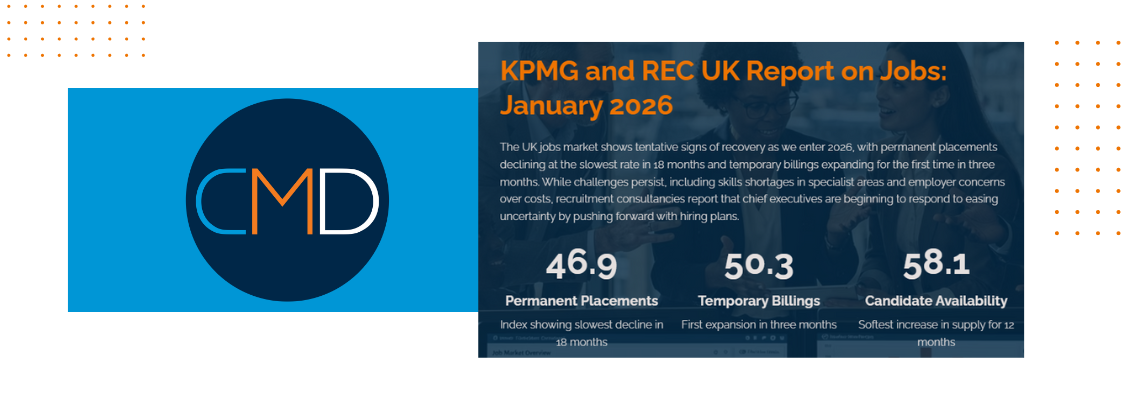
KPMG – UK Jobs Report January

UK permanent hiring fell in January at its slowest rate in 18 months, while temporary billings rose slightly for the first time in three months. Candidate availability grew at the softest pace in a year, but pay for both permanent and temporary staff increased sharply due to competition for skilled workers. Overall demand for staff […]

Read more
January 30, 2026

How to Ace Problem-Solving Interview Questions

Quick Answer:Problem-solving interview questions assess how candidates analyse challenges, evaluate information, and implement effective solutions. The strongest responses follow a clear structure such as the STAR method (Situation, Task, Action, Result) and demonstrate measurable outcomes from real workplace situations. Key Takeaways Problem-solving questions help employers evaluate critical thinking and decision-making. Using the STAR method helps […]

Read more

Employers often use problem-solving questions to assess how a potential employee will manage challenging situations, particularly those which may not be typical of the role but could crop up. We explore what you can expect and the methods to use for the most effective answers. What are problem solving interview questions? Problem solving questions usually pertain to a candidate's ability to collect data or information, process and analyse it and then form and implement a solution. They are designed to test and assess the specific skill set necessary to perform well under stress and will often focus on specific occasions when the candidate had to solve a problem. Here are a few examples: What was the most challenging situation you have faced at work? Do you always try to solve a problem on your own before asking for assistance? What do you do first when faced with an urgent problem? Describe a time when you faced an unexpected challenge at work How would you handle an unhappy customer? What are they looking for in a response? Employers ask these questions to gauge what shape your individual problem-solving process takes. They are looking for you to describe a logical process, referencing information gathering, analysis and decision making that is then based on that analysis. Select specific examples from your prior work experience to show your ability to be flexible while solving problems. Don’t generalise. Employers are looking for realistic examples that showcase your knowledge and skills. How to prepare for problem solving interview questions As with all interview situations, preparation is key, you can start this by: Considering some good examples of situations where you have had to utilise problem-solving skills beforehand. Rehearse them to make sure you are comfortable in remembering the points you need to raise. Asking other people who may have experience as an interviewer to have a practice run with you and ask them for constructive feedback on your responses. It sounds obvious but get a good night’s sleep beforehand. It’s always more difficult to think clearly and remember things when you’re tired. Likewise, eat and drink well for maximum performance. Feeling weak or dehydrated can make you feel more anxious. How to structure your response - STAR Fortunately, a structure has already been devised to assist you with your response when you identify that you are being asked a question about problem solving. The STAR technique will help you to keep your answers relevant and concise. Situation A brief description of the bare facts is what is required here. Don’t go into unnecessary detail. A few sentences to give an overall picture is sufficient. They are more interested in the following analysis and actions that took place. For example, ‘I had a situation where an unhappy customer became aggressive with members of staff. They had been offered a refund but still refused to leave.’ Technique This is where you need to succinctly define what the task or challenge was that you were presented with. For example, if the situation was an angry customer shouting in front of other customers, you might cite your role as defusing the situation as quickly as possible. Again, don’t linger on this part for too long, interviewers simply want to know that you’ve clearly identified the problem and assessed what action needs to be taken. Action This is where you refer to your active role in the situation. What did you actually do? Did you recognise the need to ask for assistance quickly enough if it was necessary? What knowledge and skills did you need to employ to resolve the problem? Identify and elaborate on a few of the most effective steps you took and refer to specific actions that were informed by your original analysis. Although you may need to reference how you worked with other team members, make sure you use the word ‘I’ rather than ‘we’ as it is your role that is being assessed, not the team position. This is the part of your answer which requires the most in depth description as this is what largely indicates your suitability. Result As is fairly self-explanatory, here you should describe how the situation ended. Did you get the result you wanted? What worked and what didn’t work? Did you learn anything from the situation that you could use to advise your approach in future? Remember, you’re not expected to be perfect, it’s more impressive to demonstrate good reflexive practice, that you have the ability to analyse your approach and hone your skills to ensure you are constantly improving your technique. Conclusion Although the unpredictability of problem-solving questions can stir up a little reticence ahead of an interview, there are ways to prepare to make you feel more confident. By adopting the STAR approach and practising your responses, you have will have all bases covered to ace that interview.

January 12, 2026

KPMG – UK Jobs Report December

The UK jobs market ended 2025 cautiously, with sharp falls in permanent placements and a modest decline in temporary billings. Weak employer confidence and rising costs slowed hiring, though pay growth improved and the market showed early signs of stabilisation. Click on the link below to find all the latest recruitment stats, data, and survey […]

Read more
January 7, 2026

How to Prepare for an AI-Enhanced Interview in the UK

Quick Answer: To prepare for an AI-enhanced interview, understand how AI tools assess your responses, practise clear and confident answers, and ensure your technical setup is reliable. Key Takeaways AI interviews assess keywords, tone, and confidence. Preparation should mirror traditional interviews. Clear, concise answers improve performance. Technical setup can directly impact outcomes. Artificial intelligence is […]

Read more

How to Prepare for an AI-Enhanced Interview in the UK

December 22, 2025

Management Accountant Interview Questions

Quick Answer: Management accountant interviews assess your technical expertise, analytical thinking, and communication skills through a mix of behavioural, technical, and scenario-based questions. Key Takeaways Management accountant roles require both technical accounting knowledge and strong soft skills. Interview questions often combine behavioural, technical, and problem-solving elements. Employers look for candidates who can analyse data and […]

Read more

Candidate and employer shaking hands at interview

December 15, 2025

Accounting Apprenticeship Interview Questions

Quick Answer: Accounting apprenticeship interviews assess your technical knowledge, communication skills, and career motivation through a mix of practical and behavioural questions. Key Takeaways Employers assess both technical accounting knowledge and soft skills. Preparation is essential, especially for candidates with limited work experience. Interview questions often focus on career goals, organisation, and teamwork. Demonstrating enthusiasm […]

Read more


Accounting apprenticeship Interview

December 14, 2025

Accounting and Finance Interview Questions

Quick Answer: Accounting and finance interview questions assess your technical knowledge, problem-solving ability, and how well your experience aligns with the role. Key Takeaways Employers assess both technical expertise and soft skills. Behavioural questions reveal how you handle real-world scenarios. Preparation with examples strengthens your answers. Knowledge of tools, reporting standards, and industry trends is […]

Read more
Candidate being interviewed for accounting role

December 8, 2025

KPMG – UK Jobs Report November

Demand for staff and placements continued to fall in November, with permanent hiring seeing another marked decline. Candidate availability rose sharply due to redundancies and fewer vacancies. Overall, uncertainty around the Budget and wider economic pressures kept the labour market subdued and employers cautious. Click on the link below to find all the latest recruitment […]

Read more

November 14, 2025

KPMG – UK Jobs Report October

Temporary billings have risen for the first time in 16 months, signalling a slight improvement in hiring confidence. Meanwhile, permanent placements continue to decline, though at a slower pace, as economic uncertainty keeps employers cautious. Click on the link below to find all the latest recruitment stats, data, and survey results from KPMG and REC. […]

Read more